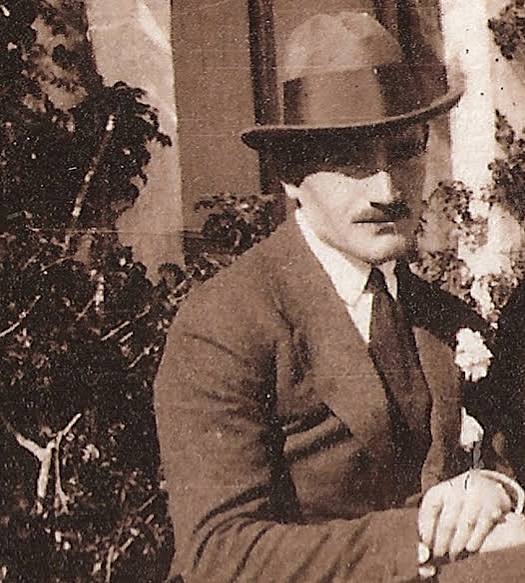
 Luis de Cuadra y Raoul (1877 - August 12, 1921) was a Spanish aristocrat, diplomat, and intellectual whose life crossed paths with some of the most
prominent European spiritual and literary figures of the early twentieth century.
Luis de Cuadra y Raoul (1877 - August 12, 1921) was a Spanish aristocrat, diplomat, and intellectual whose life crossed paths with some of the most
prominent European spiritual and literary figures of the early twentieth century.Queer Places:
C. de Ruiz de Alarcón, 7, Retiro, 28014 Madrid, Spain
Luis de Cuadra y Raoul (1877 - August 12, 1921) was a Spanish aristocrat, diplomat, and intellectual whose life crossed paths with some of the most
prominent European spiritual and literary figures of the early twentieth century.
Born into high society as a member of the Marquisate of Guadalmina (the Cuadra family held aristocratic properties in Madrid, including the residence at Calle Ruiz de Alarcón, 7, which served as a primary address for the Marquisate of Guadalmina) and the younger brother of Luis Antonio de la Cuadra y Raoul, he received a refined education that allowed him to master Arabic, literature, and Islamic theology. Seeking spiritual and personal transformation beyond the confines of his aristocratic Catholic upbringing in Spain, Cuadra converted to Islam, adopting the life of a self-described "renegade" wanderer. His spiritual journey took him through the Middle East and North Africa, where he fully immersed himself in Arab culture, language, and the traditions of Islamic mysticism.
The pivotal turning point of Cuadra's historical legacy occurred in late 1906 aboard a ship bound for Cairo. It was there that he met a young French scholar, Louis Massignon, who was traveling to join the French Institute of Oriental Archaeology. Cuadra captivated Massignon with his nonchalant elegance, fluent Arabic, and radical philosophy of total surrender to desire, introducing the young Frenchman to the subcultures of Alexandria. Their meeting initiated an intense, passionate, and turbulent romantic relationship. Beyond their physical intimacy, Cuadra served as Massignon's intellectual and spiritual guide, introducing him to Persian poet Farid ad-Din Attar’s Memorial of the Saints and the controversial 10th-century Sufi mystic Mansur Al-Hallaj. Cuadra's presentation of Al-Hallaj—a figure who embraced martyrdom out of pure love for God—ignited the central focus of Massignon's lifelong academic career and spiritual devotion.
When Massignon experienced a dramatic spiritual awakening and returned to Catholicism in Mesopotamia in 1908, the dynamic between the two men radically transformed rather than ended. Massignon reinterpreted their romantic liaison through the lens of Catholic theology, viewing Cuadra as a "fallen soul" whom he was divinely called to save. In 1909, with the formal approval and spiritual guidance of Father Charles de Foucauld, Massignon made a sacred vow of "fraternal substitution," offering his own prayers, penances, and sacrifices to God in exchange for Cuadra's salvation and eventual reconciliation with the Church. Despite Cuadra's continued secular and Islamic life, the two maintained a distant, complex correspondence. Between 1909 and 1910, Massignon composed roughly 1,400 verses of ghasaliyat-style love poetry dedicated to Cuadra before destroying them in a fit of spiritual purging.
In his later years, Cuadra struggled with deep personal turmoil, despair, and isolation, ultimately ending his life by suicide on August 12, 1921, by falling from a prison in Valencia, Spain. News of his death reached Massignon in early January 1922, triggering a profound spiritual crisis and an extraordinary series of coincidences that Massignon interpreted as divine "inter-signs." On January 18, 1922, Massignon attended Mass to offer communion on behalf of Cuadra for Cuadra's father; less than two hours later, Massignon's own father, the sculptor Pierre Roche, died suddenly of a heart attack while working on a monument to Joris-Karl Huysmans. These interconnected deaths prompted Massignon to write his spiritual autobiography, Notes on My Conversion, directly cementing Cuadra's memory as the cornerstone of Massignon's spiritual theology.
In the broader context of LGBTQ history and modern queer theology, Luis de Cuadra occupies a crucial position as an early twentieth-century figure whose homoeroticism directly catalyzed major developments in Christian and Islamic interfaith relations. The intense homoerotic bond between Cuadra and Massignon became the foundational catalyst for the Badaliya, a prayer movement founded by Massignon and Mary Kahîl in 1934 (and later blessed by Pope Pius XI) dedicated to Christian self-sacrifice for the Muslim world. Cuadra's role as a figure of "prophetic inversion" bridged the gap between homosexual passion and mystical substitution, demonstrating how early 20th-century queer relationships shaped modern Catholic views on Sufism, grace, and interreligious solidarity. Beyond academic theology, Cuadra's persona as an aristocratic, tormented convert inspired major literary creations, most notably serving as the direct inspiration for the character of Dom Camille, the noble renegade in Paul Claudel's masterpiece The Satin Slipper.
References:
Support this project
This website is a passion project researched, developed, and funded entirely by me. If you find the content valuable and would like to help support the ongoing research and hosting costs, any contribution is deeply appreciated.
Thank you for keeping this independent resource alive!
My books on Amazon: Elisa Rolle's books